Transition briefing · Public health and environment
Continuous water quality monitoring for Colorado
Summary
Colorado learns about fecal contamination, algal blooms and organic carbon in its rivers and drinking water supplies from samples collected weekly to monthly and analyzed in a laboratory a day or more later. After a wildfire, a single storm over a burn scar can change all three within hours. Optical sensors now measure each one continuously in the water: tryptophan-like fluorescence for fecal contamination, validated against EPA's acceptance test; fluorescent dissolved organic matter (FDOM) for organic carbon; and chlorophyll fluorescence for algae. Colorado institutions are already using them. CDPHE's Water Quality Control Division is reviewing a plan to adopt the fecal method for Boulder Creek, Denver Water is building an eleven-site source water network on the South Platte for organic carbon and algae as well as E. coli, and the Colorado National Guard is discussing a pilot for emergency drinking water. The same CU Boulder team supported CDPHE in the green infrastructure study required by Senate Bill 24-037, whose final report reaches the new administration in early 2027.
The incoming administration can turn this work into one statewide program by:
- getting the Boulder Creek alternative method approved in under three years: the Division answering the City's requests on its proposed dates (scope and reference method by 1 February 2027, sampling plan endorsed by 26 February) and the Commission hearing the proposal in 2028 instead of at the June 2029 basin hearing;
- deciding at the same time how CDPHE will accept data from an alternative method under the 303(d) Listing Methodology, where no procedure exists today, so the next city or utility that wants to use it knows the requirements in advance;
- making continuous monitoring of organic carbon, algae and E. coli below burn scars a standard part of post-fire response above drinking water intakes;
- convening CDPHE, Colorado Parks and Wildlife, Denver Water, the Colorado National Guard and the Division of Homeland Security and Emergency Management around a shared monitoring network and open data;
- running a 2027 pilot at state park swim beaches and an emergency drinking water pilot with the Guard;
- pointing existing monitoring funds at the streams that lack enough data for the state to say whether they are safe;
- measuring the three green infrastructure pilots CDPHE approved under Senate Bill 24-037 with continuous sensors from the start, so their effect on water quality can be shown.
The gap in Colorado today
E. coli is the state's indicator of fecal contamination in recreational water. For primary contact streams Colorado's standard is 126 per 100 mL, expressed as a two-month geometric mean2, and the 303(d) listing method generally needs five or more samples in a two-month period to place a segment on the list or take it off. A segment sampled less often than that often cannot be decided either way, which is what the 60 insufficient information units reflect.
At state park swim beaches, Colorado Parks and Wildlife closes a beach when a sample exceeds 235 per 100 mL, and samples are taken every two weeks3. A closure follows a lab result that describes water from the day before, and the beach stays closed until a later sample comes back clean.
In emergencies the same lag applies to drinking water. When the September 2013 floods overran the sewer system in Lyons, officials said the drinking water was compromised while the Colorado National Guard was evacuating residents4. Confirming that a supply is safe again depends on coliform cultures run in a lab, at the moment roads and labs are hardest to reach.
Wildfire changes source water for years. Storms on burned slopes carry ash, sediment and organic matter into streams and reservoirs, and debris from the 1996 Buffalo Creek and 2002 Hayman fires still limits storage in Denver Water's Strontia Springs Reservoir17. In July 2021, a year after the Cameron Peak Fire, Greeley stopped drawing from the Poudre River because ash and debris left the water too dark and sediment-laden to treat18. Turbidity at the intake is the warning most plants act on today. Total organic carbon, which governs coagulant dose and disinfection by-product formation, is a laboratory measurement20, and algal blooms in reservoirs are found by sampling.
Where Colorado measures today
Every monitoring location in Colorado with fecal indicator records in the public Water Quality Portal, as compiled by Open Water Quality11, drawn over the WaterNet stream network12. WaterNet maps waterways from 20 m satellite imagery with deep learning and includes small streams missing from older maps. Of 1,884 sites, 1,214 have ever been sampled for E. coli; the median site has 4 E. coli samples in its whole record, 808 have fewer than 10, and 288 have any E. coli data since 2020.
Geometric means are over each site's full record, which for most sites is a handful of samples spread across years, so the colors show where E. coli has been found high, not current conditions. Click a site for its record.
The methods
Fecal contamination
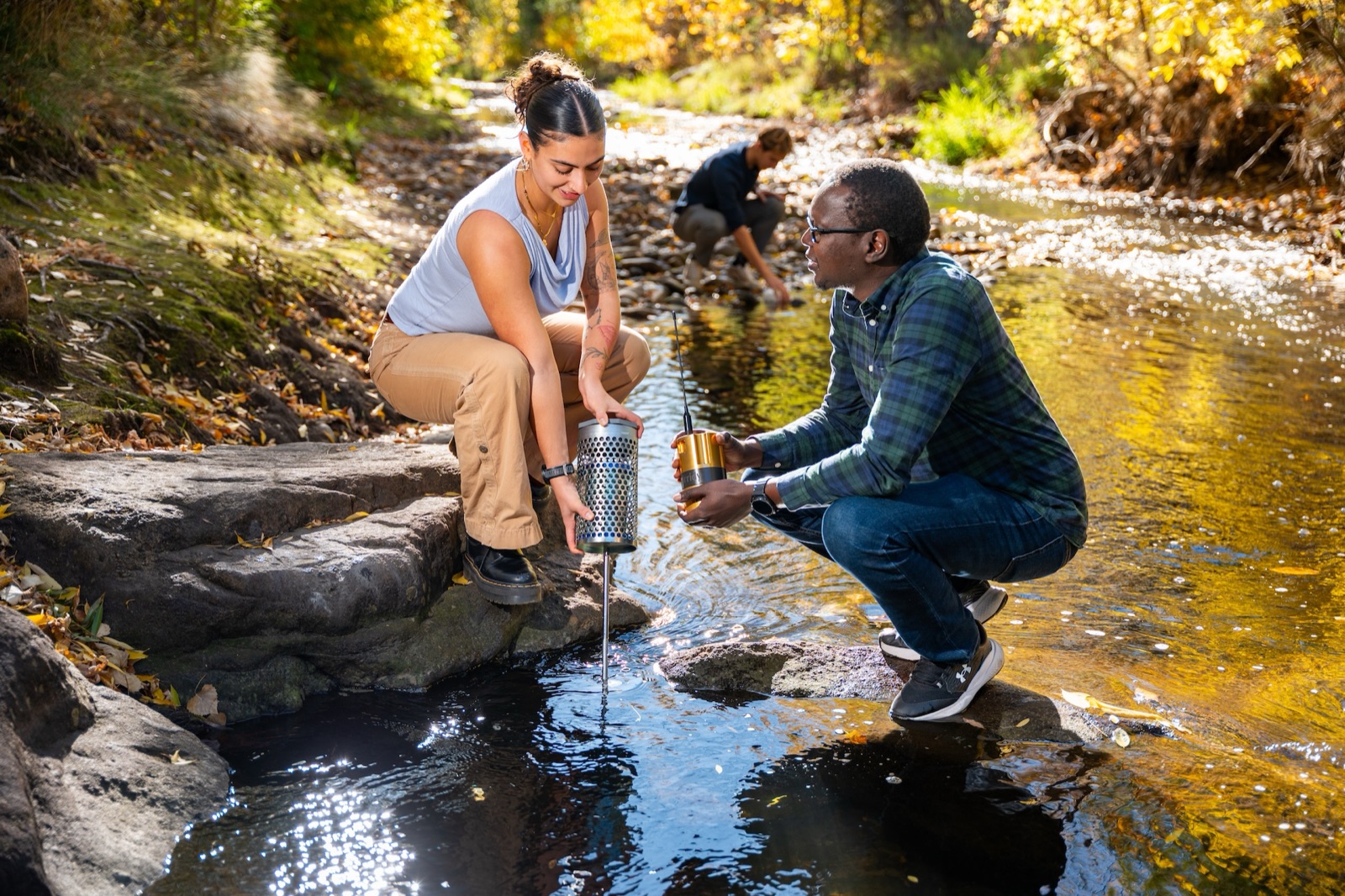
Tryptophan-like fluorescence (TLF) is light emitted by organic matter associated with fecal contamination. A submerged optical sensor measures it continuously, and a calibration against paired culture samples converts the reading to an E. coli estimate. The method is described in a manuscript under review at ES&T Water6.
EPA's technical support materials for site-specific alternative recreational criteria let a state adopt a different indicator or method if it agrees with the reference method at an index of agreement of 0.7 or higher on at least 30 paired environmental samples7. The adopted criterion keeps the existing numeric value, so the 126 standard stays in place and only the measurement changes.
| Comparison | Paired samples | Index of agreement |
|---|---|---|
| Grab samples against Colilert | 190 | 0.91 |
| Grab samples against membrane filtration | 184 | 0.88 |
| In-stream sensors, predictions published before the lab result, six Boulder Creek sites | 128 | 0.78 |
Show data table
| Station | Sampled (Mountain time) | Colilert | Sensor estimate | Scope |
|---|
The EPA threshold is 0.70. At the in-stream alarm level the sensors identified 83% of exceedances, with 68% specificity6. These figures come from Boulder Creek and from laboratory chamber tests; each new site is calibrated against its own paired grab samples, which is also how the EPA process works.
The method does not replace culture testing. Monthly paired samples continue at every site to check the calibration, and a positive sensor signal tells crews where and when to sample.
Organic carbon and algae
The same optical approach measures two quantities that matter for drinking water treatment. FDOM is the continuous stand-in for total organic carbon, and chlorophyll fluorescence tracks algal biomass ahead of a reservoir outlet or intake. Each is calibrated against the laboratory measurement it stands in for20. On the Upper Yampa River, the CU Boulder team estimated total organic carbon continuously from fluorescence sondes and 10 cm land cover imagery with a mean absolute error of 0.51 mg/L, below the 1 mg/L detection limit of the laboratory method19. Denver Water's network applies these measurements to the South Platte supply.
Work already under way
CDPHE and the City of Boulder: the regulatory pathway
Boulder Creek Segment 2b was Colorado's first E. coli TMDL, approved by EPA in September 20118, and the reach remains impaired. The City of Boulder is the proponent of a project plan, prepared with CU Boulder and Virridy and now with the Division for review, to recognize TLF corrected for temperature and turbidity as an alternative E. coli method for segment COSPBO02b16. It would be written into Regulation 38 and would change neither the 126 standard nor the Regulation 93 listing methodology. The data would serve the City's stormwater (MS4) permit, implementation of the TMDL and public notice of recreational conditions.
The plan follows the EPA technical support materials and the Commission's Policy 25-1 for external proposals9. The City raises the issue at the November 2027 Triennial Review Informational Hearing, submits application materials in late 2028 or early 2029, and is heard at the June 2029 Regulation 38 rulemaking, with EPA Region 8 approving the revision afterward.
On that schedule approval comes in the second half of 2029, about three years from now. The data do not set the pace. The EPA guidance requires 30 pairs and the 2026 record already holds 128 in-stream pairs; the remaining gaps, September through February and recession flows, close with the 2026 to 2027 winter and the 2027 season. The calendar is set by the June 2029 basin hearing. Approval in under three years means asking the Commission to hear the proposal at its own hearing in 2028, once the 2027 record closes, which is within the Commission's discretion21, and it needs the Division's answers on time in early 2027. CU Boulder analyzes every paired sample in the method developers' laboratory, and Virridy supplies the sensors, calibration, data analysis and method documentation at no cost to the agencies.
The plan asks the Division thirteen questions, and the timing lands in the first weeks of the new administration:
| Date the City asks for | Decision by the Division |
|---|---|
| 18 December 2026, final 15 January 2027 | Review and approve the project plan. |
| 1 February 2027 | Confirm the scope (whole segment COSPBO02b), how the method is written into Regulation 38, and the June 2029 hearing schedule. Confirm single-laboratory (Tier 1) validation at CU Boulder and Colilert as the reference method. |
| 26 February 2027 | Review and endorse the sampling and analysis plan before the 2027 season. Endorsement before sampling counts toward Policy 25-1 ripeness. |
| Before the November 2027 hearing | State what is needed to accept TLF as a documented protocol under the Listing Methodology; whether the 2026 record counts toward validation; which Policy 25-1 timeliness reason applies; whether TLF data can be used from the approval date or earlier, including at the May 2029 Regulation 93 hearing; and coordinate EPA Region 8. |
We found no state that has adopted an alternative indicator under the 2014 EPA guidance, so these answers set Colorado's precedent. The question with statewide reach is the one on the Listing Methodology: no CDPHE-approved TLF method exists, and how the Division answers will decide whether a second city, utility or MS4 permittee can use continuous data in an assessment without starting from the beginning.
Denver Water: source water, algae and wildfire
Denver Water draws drinking water for 1.5 million people from the South Platte and its North Fork5. Under the NSF Ascend regional innovation engine, Denver Water, CU Boulder, OpenCurrent and Virridy are building a continuous monitoring network at eleven points from below Cheesman Reservoir to the raw water entering the Foothills and Marston treatment plants20. Denver Water's priority parameters are FDOM, chlorophyll-a, total organic carbon, turbidity and alkalinity, and the sensors add E. coli. Six sensors have run at three South Platte locations since 2 October 2026, each location pairing a TLF unit with an FDOM unit. The network is built for the events that change source water within hours: a storm over a burn scar, an algal bloom building behind Strontia Springs Reservoir, or a wastewater or recreational input on a tributary.
The City and County of Denver's Department of Public Health and Environment ran sensors on the South Platte and Bear Creek during 2026, paired with its own Colilert samples, which extends the record to recreational reaches in the urban core.
Colorado National Guard: emergency drinking water
The Guard is the state's response force for floods and wildfires, the events most likely to compromise drinking water, and a deployable sensor kit could watch a supply below a new burn scar through its first storms. Mike Bunting of CU Boulder's Center for National Security Initiatives has recommended a funded pilot through the Guard's United States Property and Fiscal Officer, whose contracting office buys on the Guard's behalf. A small commercial purchase can proceed once the Guard names a unit that owns the requirement and identifies funds. The same sensors are in testing with the Air Force Research Laboratory, on loan to the Army's 25th Infantry Division, and the subject of a cooperative research agreement with the Army's Soldier Center that is in final signature, so a Colorado pilot would draw on federal military evaluation already under way.
Senate Bill 24-037: green infrastructure pilots
Senate Bill 24-037 directs the University of Colorado and Colorado State University, with CDPHE, to study alternative compliance programs that use green infrastructure and to establish up to three pilots13. The CU Boulder team held weekly check-ins with CDPHE through 2025 and in December 2024 completed a feasibility study ranking candidate pilots; Longmont, a Steamboat Springs water quality trading program and Plum Creek scored highest. CDPHE approved three regional pilots on a three-year timeline, a draft report went to CDPHE in October 2025, and the final report is due in early 2027. The City of Longmont has applied to host a demonstration project. An analysis of how water quality trading experience applies to the bill is published in JAWRA14.
In the team's survey of 167 practitioners and 27 interviews, regulatory constraints were the barrier to nature-based water quality solutions named most consistently, and respondents asked for continuous monitoring to set baselines and measure the effect of restoration15. The pilots are where that monitoring would first show results: a green infrastructure credit in an alternative compliance program depends on demonstrating the water quality change it buys.
A statewide program
| Tier | Where | Lead | What it answers |
|---|---|---|---|
| Rivers and streams | The 60 units with insufficient E. coli data first, then listed segments with TMDLs | CDPHE Water Quality Control Division, with local MS4 permittees | Whether a segment attains the standard, with every two-month period covered |
| Recreation | State park swim beaches, starting with Chatfield and Cherry Creek; urban whitewater and play parks | Colorado Parks and Wildlife, local public health | Whether the beach is safe today, with closures and reopenings decided on current data |
| Source water and burn scars | Watersheds above drinking water intakes, starting with burn scars such as Cameron Peak on the Poudre and Hayman and Buffalo Creek on the South Platte | Utilities, CDPHE drinking water program | When organic carbon, algae or E. coli is rising upstream of an intake, before it arrives |
| Emergencies | A deployable kit for floods and new wildfires | Colorado National Guard, DHSEM, local utilities | When a supply is compromised and when it has recovered, between lab confirmations |
All tiers should publish to one state data platform maintained by CDPHE, open to the public, so the same reading serves a permit holder, a park manager and an emergency manager. Culture testing continues at a reduced, fixed schedule at every site as the calibration and audit check.
Equipment cost is small relative to sampling labor. At Virridy's published price of $2,400 per sensor per year, a 50-site first phase costs $120,000 a year for sensors and data. The paired laboratory samples are an added cost that depends on how each agency runs them. Procurement should be competitive and specify the method and its EPA acceptance test, so that any sensor meeting them can bid.
First 100 days
| When | Action | Owner |
|---|---|---|
| January 2027 | Approve the Boulder Creek project plan and answer the City's scope, schedule, single-laboratory and reference-method requests by 1 February, with staff time assigned to meet the dates. Ask the Commission to schedule a 2028 hearing for the proposal. | CDPHE executive director, Water Quality Control Division |
| February 2027 | Endorse the Boulder Creek sampling plan by 26 February, and set out how alternative-method data will be accepted under the Listing Methodology for any proponent. | Water Quality Control Division |
| February 2027 | Convene a working group of CDPHE, Colorado Parks and Wildlife, Denver Water, the Colorado National Guard and DHSEM. Agree on a shared data platform and site priorities. | Governor's office, CDPHE |
| March 2027 | Ask the Adjutant General to identify a Guard unit and funding for an emergency drinking water pilot through the USPFO. | Governor, Department of Military and Veterans Affairs |
| April 2027 | Before the summer storm season, agree with utilities whose intakes sit below burn scars on continuous monitoring of organic carbon, algae and E. coli, and on how readings reach CDPHE and DHSEM. | CDPHE, DHSEM, utilities |
| April 2027 | Approve a swim season pilot at Chatfield and Cherry Creek, with continuous sensors alongside the existing two-week sampling. | Colorado Parks and Wildlife |
| Early 2027 | Receive the SB 24-037 final report and fund the three approved pilots with continuous monitoring built in. | CDPHE Water Quality Control Division |
| Budget cycle | Direct monitoring funds, including federal Clean Water Act Section 106 program funds, toward units with insufficient E. coli data. | CDPHE, Office of State Planning and Budgeting |
Disclosure
Evan Thomas is a professor at the University of Colorado Boulder and the chief executive of Virridy, which makes the Lume sensor used in the projects described here. Virridy is party to the Denver Water, City of Denver and Department of Defense work, and supplies sensors to the Boulder Creek project. The method itself is published and any instrument that meets the EPA acceptance test could serve the program. Any state purchase should be competitive, and decisions about the program should be made by staff without a financial interest in its outcome.
Sources
- US EPA, ATTAINS assessment data, Colorado 2024 reporting cycle (EPA final action), queried 10 November 2026. 78 assessment units list E. coli as a cause of impairment; 60 list E. coli as insufficient information. epa.gov/waterdata/attains
- Colorado Water Quality Control Commission, Regulation 31, 5 CCR 1002-31, Table I, footnote on E. coli two-month geometric mean; and the Commission's 303(d) Listing Methodology, 2026 cycle. cdphe.colorado.gov
- Denver7, "Swim areas at Chatfield, Cherry Creek State Park closed due to elevated E. coli levels." denver7.com
- CBS Colorado, "National Guard airlifts thousands from flooded Lyons," 13 September 2013. cbsnews.com
- Denver Water, About us. denverwater.org/about-us
- Thomas et al., tryptophan-like fluorescence as a fecal indicator method, manuscript under review at ES&T Water, 2026.
- US EPA, Site-Specific Alternative Recreational Criteria Technical Support Materials for Alternative Indicators and Methods, EPA-820-R-14-011, December 2014. epa.gov/wqc
- City of Boulder, E. coli in Boulder Creek. bouldercolorado.gov/e-coli-boulder-creek
- Colorado Water Quality Control Commission, Policy 25-1, Advancing External Proposals, adopted 12 May 2025.
- Colorado Newsline, "Colorado Gov.-elect Phil Weiser names transition team," 4 November 2026. newsfromthestates.com
- Open Water Quality, global surface-water fecal indicator monitoring sites compiled from public sources; Colorado sites from the Water Quality Portal (EPA, USGS, NWQMC), extracted 10 November 2026. openwaterquality.org
- Pierson, M., Fankhauser, K., Mehrabi, Z. (2026). Mapping waterways worldwide with deep learning. arXiv:2412.00050. Data: Fika and Better Planet Laboratory, WaterNet global waterways, Source Cooperative, doi:10.60480/a3sb-an07, CC BY 4.0. source.coop/fika/waternet
- Colorado General Assembly, SB24-037, Study Green Infrastructure for Water Quality Management. leg.colorado.gov/bills/sb24-037
- Landon, T., Johnson, A., Thomas, E. (2026). Applying water quality trading experience to Colorado Senate Bill 24-037. Journal of the American Water Resources Association 62(3), e70136. doi:10.1111/1752-1688.70136
- Demaree, K., Johnson, A., Andersson, K., Thomas, E. A. (2025). The nature-based paradigm shift: identifying and overcoming barriers to sustainable water quality solutions. ACS ES&T Water 5(6), 2945-2952. doi:10.1021/acsestwater.4c01053
- City of Boulder, CU Boulder and Virridy, Boulder Creek E. coli Alternative Indicator Project Plan, draft for Division review, November 2026.
- Denver Water, "Taking the wild out of wildfires," 31 October 2025. denverwater.org
- CBS Colorado, Greeley halts use of Poudre River water after Cameron Peak Fire ash and debris, 6 July 2021. cbsnews.com
- Demaree, K., Fankhauser, K., Cole, G., Ross, M. R. V., Thomas, E. A. (2026). Sensor informed predictive model for total organic carbon and nutrients on the Upper Yampa River. ACS ES&T Water 6(2), 679-688. doi:10.1021/acsestwater.5c00759
- Denver Water Source Water Monitoring Network, site and parameter list supplied by Denver Water. thelume.ai/denverwater
- Colorado Water Quality Control Commission, Public Participation Handbook, September 2007, on the Commission's discretion to proceed with rulemaking on a petition.